Mobile app + AI
Hikam Shughro
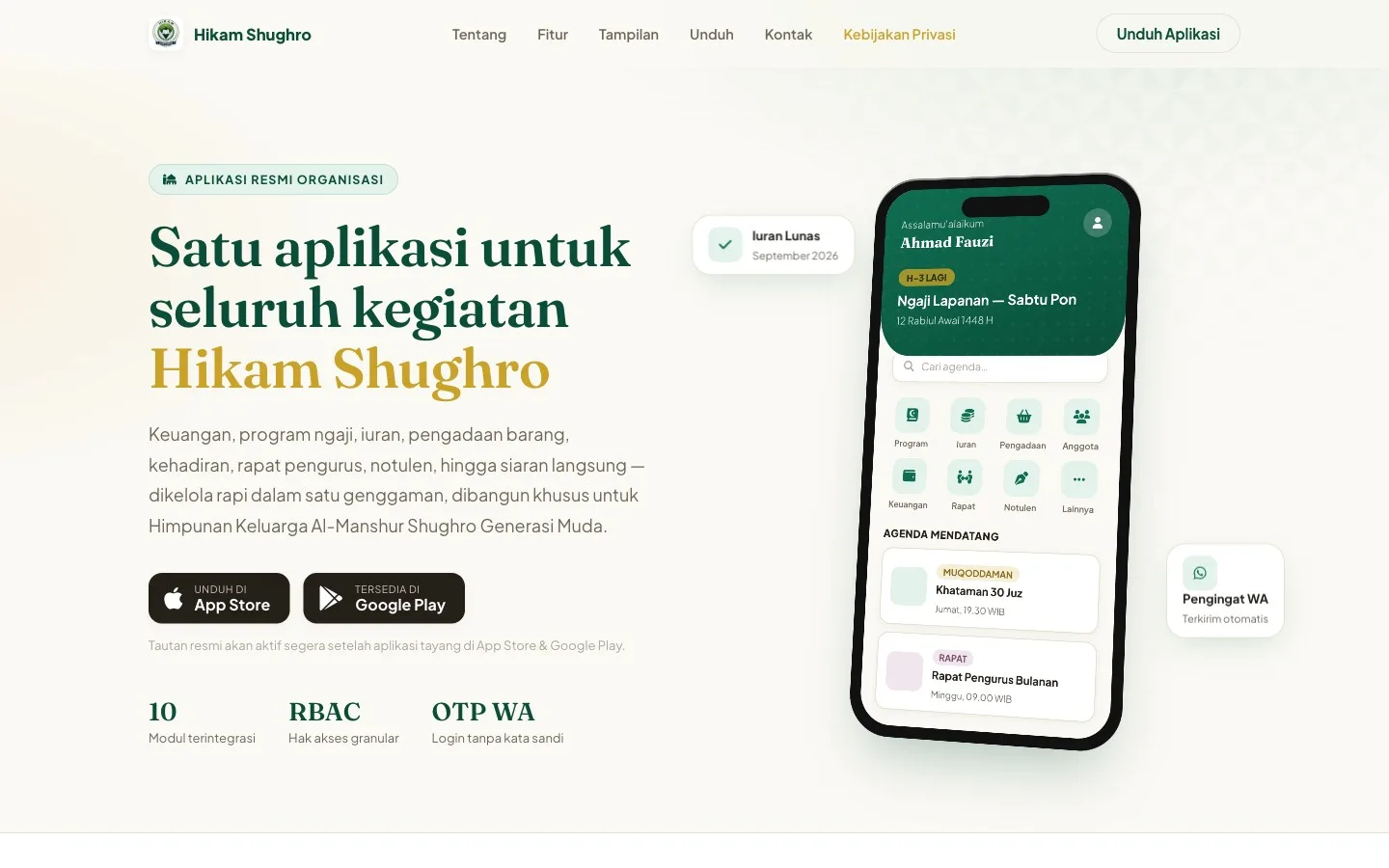
A Flutter app with its own Node.js backend for a community organisation: finance, dues, attendance, meetings, minutes, procurement, live sessions and a book library. Maktabah AI answers from reference books with citations (RAG on a Qdrant vector database), and meeting recordings are transcribed with Whisper large-v3 into minutes.
The problem
Coordination ran on handwritten notes and WhatsApp groups where things got lost: cash, dues, attendance, minutes and procurement.
What it does
- One mobile app with 22 feature areas, including finance, dues, attendance, meetings, minutes, procurement, policies, live sessions, prayer times and a book library.
- Passwordless login with a one-time code sent over WhatsApp, and permissions per position.
- Maktabah AI answers questions from the reference books and cites the passages it used.
- Meeting recordings are transcribed with Whisper large-v3 and turned into minutes.
- Live sessions through LiveKit, dues and donations through Midtrans, push reminders through Firebase.
How it is built
- Flutter app (Riverpod) with its own self-hosted backend: Fastify, MySQL through Prisma, Redis with BullMQ and Socket.IO.
- A Qdrant vector database for the book assistant.
- PM2 process configuration; released on Google Play.
How AI is used
- RAG: documents are split into chunks, embedded, stored in Qdrant, retrieved and passed to an OpenAI-compatible chat model, which answers with citations.
- Speech-to-text with whisper-large-v3 through a self-hosted proxy, then an AI step that writes the minutes.
- A vision model can read scanned book pages. Model names are set by environment.
Honest notes
- Automated test coverage is minimal.
- The same codebase also served as the source for a second organisation’s app that has not been released.
Engineering depth
Counts taken from the repository itself, not performance claims.
- 22
- feature areas in the app
- 50
- database models
- ~180
- route handlers in 15 groups
- 107
- commits